Recently, while cooking dinner, I reached for the salt shaker near the stove and discovered it was empty. My next move was to open the upper cabinet door to the right of the stove, where, normally, there is a box of salt to use when refilling the shaker. But, alas, there was no box of salt to be found. I still wasn’t concerned, because I thought I remembered buying a new box of salt a few weeks prior to this. Sure enough, in the pantry I discovered a new and unopened box of salt.
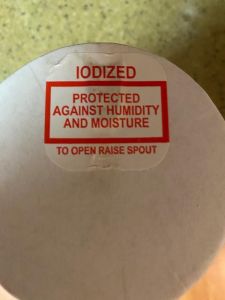
You can see the picture of the top of that box of salt at left. I discovered that the salt was iodized and that it was protected against “humidity and moisture” (which I think are the same thing?). To gain access to that protected and iodized salt, I needed only to “raise spout.” I’ve opened quite a few boxes of salt in my lifetime, and I’m not even sure what prompted me to pay attention to this label. We all know that the spout is under the protective cover, even though it doesn’t tell me that.
But what if I had never seen a box of salt? How would I know that under the piece of paper with the information about the salt is a tiny metal spout through which the salt could be poured into my empty salt shaker? If you look carefully at the picture, you can see a vague outline of the spout, but had I never seen a typical American version of a box of salt, would I notice it?
All of that got me to wondering a bit about Scripture. Not in the sense of thinking about Lot’s wife becoming a pillar of salt, or Jesus calling me to be “the salt of the earth,” or even the great “Salt Sea,” otherwise known as the Dead Sea. What I’m wondering about is “the covered-over spout.”
I regularly caution students in my classes – as I caution myself – that we need to be careful about placing what I call “theological systems” over the content of Scripture. I remember reading a sermon – a seven-point sermon at that – in a preaching journal where a preacher’s text was the story of Isaac meeting Rebekah (Genesis 24). The preacher used the nature of a camel’s body to preach about grace. I’m all about grace, but I’m confident that text had nothing to do with grace.
What if, every time we decided to study a text of Scripture, we committed ourselves to taking off all the “stuff” that we allow to cover the actual text of the Bible and letting it speak for itself? Or, in the analogy of the salt box, what if we made sure we found and opened the spout? The salt in that box has no real value if I don’t open the spout. The same is true of Scripture.
Of equal importance, is it possible that often the church, or people in the church, cover up the spout – perhaps with good intentions? In the end, unless someone listening to us knows there is a spout under the covering, they will never discover what Scripture is attempting to communicate.
When I listen to and read of lot of the public conversation of the church, it seems like we might be guilty of putting all sorts of coverings over the actual message because we aren’t sure “certain people” ought to see it.
For example, if you are required to get through my political opinions before you can ever hear what Scripture says, there is a good chance you may think the Bible and my politics are the same. If that happens, I have just covered up the spout! You may not even know there is a spout.
If you are required to culturally fit my standards of how to dress, what sort of employment is noble, where your neighborhood is located, and my preference for worship style, there’s a good chance you will never hear what Scripture actually says.
If you are a part of a political group that you’ve heard me call “Demoncrats,” what are the chances that you will give me an ear? Or, in equally the same way, if you’ve heard me call you “Jim Crow 2.0” because you are a part of the other political group, would you have any interest in hearing what I have to say about Scripture? Could our fascination with labeling these days be the cover that hides the spout?
If I think about this long enough, I begin to wonder if our lack of civility and common decency functions as one of the opaque coverings we place over the Jesus story as found in Scripture.
Sometimes we even use parts of the Bible to cover up the Jesus story in significant ways. I remember teaching a class in which we were discussing the issue of global poverty. I decided that as a part of our discussion, we should at least consider the story of the rich young ruler, which all three Synoptic gospel writers choose to record (Matthew 19:16-30; Mark 10:17-22; Luke 18:18-30).
I asked, “What causes poverty?” One student was the first to answer, adamantly: “Laziness.” That student was throwing verses from Proverbs around left and right. In particular, he was all about Proverbs 13:22, “the good leave an inheritance for their children’s children.” I’m not discounting the value of Proverbs, but I’m confident when it comes to the economy of the Kingdom of God, I ought to listen to Jesus, not Solomon.
Could it be that we have allowed our possessions to place a covering over the “spout” of the Jesus story in such ways that we never actually get to what Jesus is all about? Truth be told, most of us prefer to view ourselves as somewhere south of being rich, and we don’t want Jesus plundering around our investment accounts. Can I do that and ever find and open the spout?
All of the arguments that have erupted over “personal freedom” versus “concern for others” during the pandemic seem to have placed a very thick cover over the spout that give access to the Jesus story. The pandemic will have more unintended outcomes than I suspect we can count. I pray that one of those outcomes won’t be another chasm in our attempts to get the Jesus story out of the box, so to speak, because we put a label over the spout.
The Bible is an inviting book filled with all kinds of stories, all kinds of comfort, and all kinds of instruction. And yes, it generates all kinds of questions. But if we have “covered over the spout,” it is entirely possible that some will never get to that amazing content, because they don’t know there is a spout through which those stories can get into the salt shaker of their own lives.
I’m going to spend some time today thinking about the labels I may be guilty of placing over the spout and seeking God’s help in removing them.
 Wye Huxford