My friend and longtime colleague, Byron Cartwright, shared this with me in response to my most recent blog post. With his permission, I’d like to share it with you.
It’s not that I am against new songs, new lyrics, new musical techniques. Throughout my life and musical career, I have celebrated fresh sounds and perspectives, and I have learned and performed incredible amounts of “new” music, in almost any genre. However, I find my soul enriched over and over in today’s world by music which I had forgotten from many years ago — “old music.” Sometimes it’s the music or text, but often it is the associations that accompany hearing sounds from long past. Granted, the nostalgic associations are often tinged with sadness when I recall people who have left this world and the type of performances which are no longer possible in today’s musical world. But more and more, I am learning to find joy in reliving old music and people who brought that music to life for me.
There are some people and events which have recently called me to rejoice through sorrow. Wye Huxford’s blog post, “The Curse of a Cheap Bookshelf,” which referenced his wife, Vicki, and her organ music, was poignant to me. It was a fresh recall of one week ago, when Katie and I sat in Don Seever’s Florida condo great room, listening to him play the three-manual Allen organ which used to be in the sanctuary of First Christian Church, Clearwater, Florida. This past Sunday morning, while listening online to Larry Jones’ sermon from Northside Christian Church, Yorktown, Virginia, I experienced another musical deja vu which fed my spirit. At the close of his sermon, Larry sang a song he had heard his mother, Betsy, sing when he was growing up. The song went, “If you know the Lord, you need nobody else to see you through the darkest night.” I was in high school, and Larry’s mother, Betsy, was Ray “Cotton” Jones’ (the senior minister’s) wife; she had a lovely soprano voice. I also heard her sing this song decades ago, but I had completely forgotten it until Larry began to sing. Instantly, the words and music returned to me, and I sang along with Larry — not missing a word! The old song spoke to me in a very fresh way.
These incidents from the last week blessed me richly and brought me to a beautifully sad, but peaceful place today, as I received word this morning that Betsy Jones passed away. I genuinely rejoice that Betsy is now free from pain, as I rejoiced several months ago, in a similar complex way, when Vicki Huxford’s terrible suffering ended. When Don Seevers performed for Katie and me last week, he had just returned from celebrating his mother’s 90th birthday. Dying is all around us, and for those of us circa 70 years old, aging prompts us to process life’s music more profoundly.
Old songs now bless my life more than when they were new! Wye recalled Vicki playing Bach’s Toccata and Fugue in D Minor (which is almost 300 years old) for her master’s recital shared with Beth Mays under Professor E. Wayne Berry, who was my organ teacher, too. Larry recalled his mother’s song from 50 years ago; Don played organ arrangements of “All Hail the Power” and “A Mighty Fortress” (a very old hymn and a very old chorale), and he performed both on an organ (in excellent shape!) more than forty years old. People today may find the organ outdated and curious, but its sound in Don’s condo was exhilarating — perhaps somewhat so because it has become uncommon to many modern worshippers. It sounded like an old friend to me! I scoured Don’s piano/organ music library and found an arrangement of “Love Was When.” Katie and Don played the piano/organ duet of this old song, which is seldom heard these days. Once again, music and words spoke to me on many levels. The sheer sound of the Yamaha grand piano, the Allen organ, and skill of the performers combined to create great joy for my listening ears.
Yes, I want to hear more old music, more old hymns, more classical music, even more songs from the many volumes of “Favorites” in the Singspiration gospel series of the 1950s and 1960s. (There were some gems in those books, though they were considered “popular” Christian music of commercial value, back in the day!)
When I think of musicians like Wayne Berry, Vicki Huxford and Betsy Jones, and a host of others, I miss them, but I still find delight in what their music and the music of even older musicians has left recorded in my mind and heart. (I admire the technology available for every kind of digital music on phones, iPads, and computers, but simply having the music in my head serves my special need in a very personal way.) I don’t want to be young again; experience gained in order to reach this point in life can be difficult to recall, let alone relive; therefore, I don’t want to relive the past! However, I do want to rejoice in what God has given me through the recalling of music of yesteryear. It’s a blessing worth the tinges of sadness and nostalgia which resurface. I think of such musical recalling as the overlap of present-earth with new-heaven and new-earth in God’s world of creation, much as the modern-day theologian N. T. Wright explains.
For those of us still living and recalling glorious musical connections — Wye Huxford (enthusiastic attender of all music programs); Don Seevers (piano student of Katie Cartwright and organ student of E. Wayne Berry’s protégé, Mary Ann Jordan, teaching colleague of Byron, Katie and Beth); Beth Mays (student of E. Wayne Berry and Mary Ann Jordan, piano teacher of Larry Jones’ wife, Jane Jones); Larry Jones (singer in Byron’s CBS men’s chorus); Jane Jones (Larry’s wife, accompanist for Byron’s men’s chorus); Katie Cartwright (graduate school piano teacher for Vicki Huxford, teacher and colleague of Don Seevers, music theory professor for Jane Jones, two-piano recitalist with Beth Mays); and Byron Cartwright (student of E. Wayne Berry and Mary Ann Jordan, conductor of choirs in which Larry Jones, Jane Jones, Don Seevers, Vicki Huxford participated, teacher and colleague of Don Seevers and Beth Mays) — the inter-connectedness of our lives is very complex! And . . . our musical connections and reflections are immeasurable.
The connections, reflections, and relationships of all those listed above, though marked by inescapable sorrow in life, cause us to rejoice in this present world because of the tie that binds us in Christian love and the music we have shared — often years ago in real time, yet somehow current now and forever etched in our minds and hearts. Our rejoicing through sorrow has taken place in greater Cincinnati, Ohio; Lexington, Kentucky; metropolitan Atlanta and many cities in Georgia; Yorktown, Virginia; Indianapolis, Indiana; several cities in Florida; Lanett, Alabama; and Phoenix, Arizona.
I dare to say that our music (and the music of multitudes in the past!) has a future component, too. Music will be shared in the new heaven and new earth promised to us as new creatures in Jesus Christ. I believe that we will sing (and play) to the Lord “old” as well as “new” songs! After all, in God’s counting of time, “old” and “new” have somewhat different meanings than they do to us. There is one undeniable characteristic of future rejoicing in music. Future music shared in the new heaven and earth will have no context of sorrow. There will be no more tears; the apostle John made that point clearly in the book of Revelation.
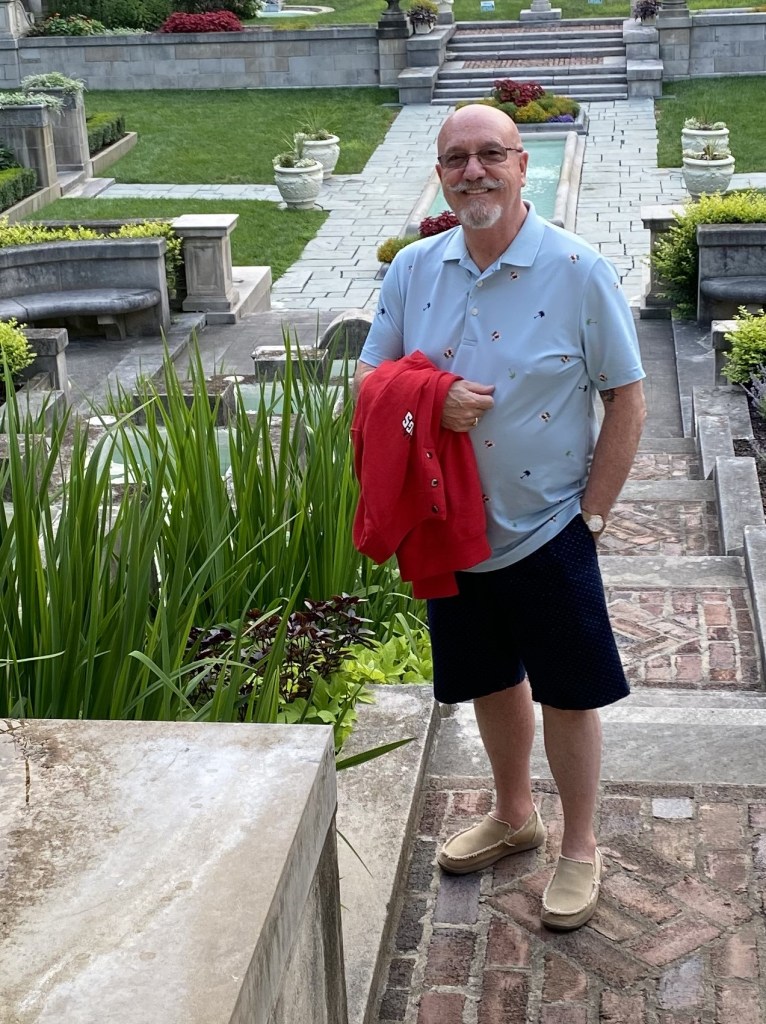
Byron Cartwright, DMA, is a retired church musician and music professor. His 50-year professional career included ministries in Ohio, Arizona, Georgia, and Alabama and professorships at Cincinnati Christian University and Point University. He now enjoys writing, gardening, traveling with his wife, Katie, time with family, and general puttering around his home and garden in Lanett, Alabama.
 Wye Huxford