Sometimes you hear a sermon or read an article or book that is clearly convicting, but the spirit with it was preached or written is such that we find ways to dismiss it because it is so strident and unkind. You really can’t do that if you read Dr. Michael Reynolds’ Still Off-Base About Race! It is convicting and, sometimes, very direct. But it is written in a spirit that invites thoughtful and careful response.
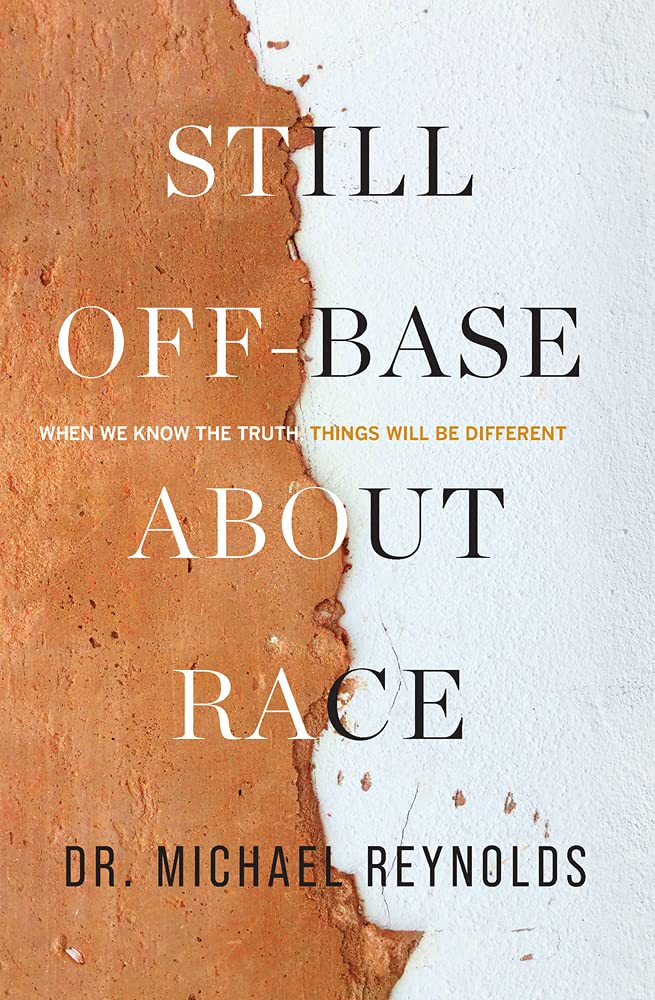
It is “preaching” in the best sense of that word – “a call to come along side of” (a better definition of one of Paul’s preferred words for preaching, parakaleo). As I read the words of this book, I felt as though Dr. Reynolds and I could walk together down a long, and sometimes troubling, sidewalk, arms around each other’s shoulders, seeking solutions for ancient challenges for the church.
In the very first story he tells, Dr. Reynolds sets the book up as well worth the time and effort to read it. It is about a white pastor with serious car problems and little money, stranded in Chicago. Without realizing he was calling a church in a predominantly Black neighborhood, the Southern, white pastor reached out for help. He soon found himself and his family being rescued by four men who were sent out from Wednesday night Bible study at Dr. Reynolds’ church to help this desperate family.
The church had the car towed to a repair shop. Dr. Reynolds and his family welcomed this pastor and his family into their home, where they would stay much longer than anticipated. The car repair bill was huge – they needed a new transmission. His church back in Mississippi wouldn’t wire him money to cover the bill. Dr. Reynolds’ church covered the bill.
When the family was ready to head back home, the Southern pastor wanted to take a walk with Dr. Reynolds. He confessed that his family were former Klan members, and until he met Christ, he shared their views. But that week – well, that week the gospel broke out in this Chicago neighborhood, and the pastor realized he “was still off-base about race.” He then said, “I really want you to come to Mississippi and preach for me. But you can’t.”
It is easy to get a bit spiritually smug when it is Mississippi and not your home state. This book won’t let you get smug like that. But it will remind you that there is a kind of latent racism in our culture that can easily raise its ugly head when least expected.
The book begins with three well-written, succinct chapters on how the scientific disciplines of biology, sociology, and anthropology dismiss any legitimacy to any remote idea of racial superiority. Race and such distinctions have no roots in science regarding what it means to be a human. My favorite line from these chapters is, “There was only one Adam, and there was only one Eve. God did not make five Adams and five Eves.” (page 50) It is a bit of an oxymoron to have a very literalist view of the creation accounts in Genesis 1 and 2 while harboring racist attitudes that suggest the superiority of your own race!
From there, the book surveys the history of racism in the United States, from the arrival of the first enslaved people to the Civil Rights Era in the 1950s and ’60s. Most of what I read in this section was a reminder to me of what I’ve read over the years, either because I love history, have read biographies of all American presidents and of people like MLK, John Lewis, Benjamin Mayes, and other Civil Rights leaders, or have read books like A Mighty Long Way and Caste, as well as other similar and interesting books. History can, when well written, be convicting!
Near the end of the book is a chapter titled “God’s Perspective on Race.” This is a fantastic chapter, starting with a reminder that “the Genesis account shows that humanity was created by God from only two people. We all belong to the same parents.” (page 168) The heart of the chapter might very well be identified when Dr. Reynolds writes, “I am convinced one of the major sins people commit today is trying to get rid of the God who holds them accountable: a God of conviction, a God who tells them they are wrong, a God who defines the problem as sin. It is hard for the church to speak clearly about sin when so many people justify their personal beliefs and behaviors.” (168) This chapter ends with this reminder, “Why are we still off-base about race? Frankly, for many people, civil rights and racial matters are social issues rather than spiritual ones.” (177) The whole chapter is a calling to walk alongside of, arms around shoulders, on a long sidewalk toward justice, and that is authentically convicting.
In the final chapters, we read about our need for a CQ as well as IQ. CQ is the measure of our ability “to interface with people of different cultures.” (186) Dr. Reynolds suggests that it takes intention and courage to deliberately practice cultural engagement with people who are different from us. But we will remain “off-base about race” until we learn to do that – both individually, as followers of Jesus, and corporately, as the body of Christ in the world in which we live. He offers “a final exam” which consists of three tests that we can use – both individually and corporately – to help us work on these issues.
In a podcast in which N.T. Wright and Esau McCaulley were talking about the gospel and race, Dr. McCaulley used the phrase “over-realized eschatology.” Realized eschatology, of course, is the commonly used phrase to describe the Kingdom of God as “already here, but not yet consummated.” McCaulley suggested that one of the reasons the church says so little about the sin of racism is “over-realized eschatology” – that is, we think we have solved this problem.
A quick read of Dr. Reynolds’ outstanding book will instantly help you realize we have not quite made it there yet.
 Wye Huxford