Early on Thursday morning, 9 April, I was sitting at my desk at home getting ready to lead a Zoom-based class later that morning. I heard what sounded like a jet airplane landing nearby. I ran outside to see what was happening just as one of my daughters, who lives next door, came dashing out to make sure her parents were okay.
It wasn’t a jet plane! Rather, it was a massive, old hickory tree that fell. Thankfully, it fell away from our home, not toward it. Best I could estimate – based on rings – the tree was about 150 years old. It took a very efficient crew of six tree experts about 12 total hours to remove. The cause of the demise of the tree was decaying roots that couldn’t be seen. The only good thing I can say about the tree no longer standing is that my garden gets better sunlight each day. But I’d rather have the tree back!
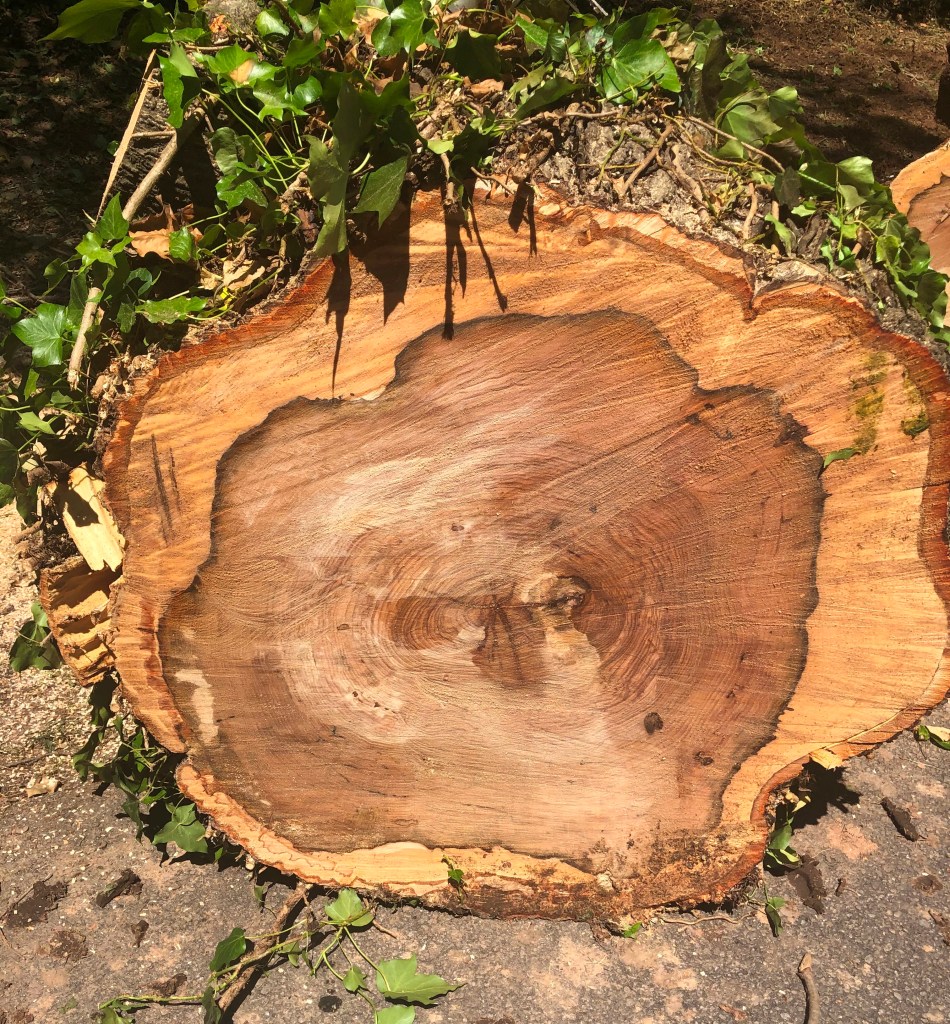
I’ve been thinking about that tree this week, as the tree folks sawed it up, ground up limbs (that weren’t too big for the grinder), hauled off massive logs, and left some chips behind for me and my garden. If the number 150 is correct for how old the tree was, that means it sprouted out of the ground sometime in the spring of 1870 – perhaps about this time of the year; I’ve seen a few pine and oak sprouts just emerging in the past few weeks.
That would have been in the aftermath of the Civil War, a time of great uncertainty and difficulty in the south. From what I’ve been told, our house sits on what was the location of the main house of a large cotton plantation. For those people – some formerly enslaved – the world had certainly turned upside down in many ways, never to be the same.
Had the tree been big enough, it could have become an infamous lynching tree. That was happening with far too much ease in this part of the world back in those days. It could have been a place where Jim Crow politics were talked about under its ever-extending limbs.
The tree was alive in the midst of World War I. Lots of young adults from Georgia would end up dying in what was hoped to be “the war to end all wars.” But we all know that didn’t happen.
The Spanish Flu pandemic of 1918-19 would have been witnessed by this tree as well. It is hard to imagine how frightening that must have been – globally.
The Great Depression would have been witnessed by this tree. Couple that horrendous global event with the boll weevil and cotton farmers – perhaps like the one who owned the land where this tree was in its mid-50s by then – and what can’t be denied is that this tree saw some pretty awful times, certainly a pandemic of poverty and hardship.
FDR spent a lot of time just south of where this tree was growing – down in Warm Springs, Georgia, and the Little White House. He was known to travel around the countryside while in Georgia. Who knows, he might have even stood under this old tree!
Soon, World War II would emerge out of the ashes of a failed peace treaty on one side of the world and globalism out of control on the other. (I realize that is a simplistic summary, but I think it is fair!) Lots of young men and women from this part of the world would lose their lives in that conflict.
The tree would have witnessed the polio issues of the late 1940s and beyond. All the childhood illnesses like measles, mumps, chicken pox, etc. – that vaccines have now made manageable – would have been in full swing. Little kids with smallpox vaccine scars on their arms likely played under its shade.
Conflicts in southeast Asia, particularly Korea and Vietnam, would claim their victims from among people who might have stood under the tree. If what I find in the ground when digging to plant something new is any indication, that tree might have been a “shade-tree mechanics” kind of place. Did some of those young adults end up victims of those conflicts?
Of course, since 1948, that tree had lived during times of great upheaval and turmoil and war in the Middle East. No doubt it is possible that people who might have stood under its shade were sent off to war in places like that.
Do you remember the flu pandemic of 1968-69? That tree was here. Or what about the AIDS crisis of the 1980s and ’90s? SARS was a frightening time as well. That tree remembers.
Then there is 9/11 and the subsequent wars on terrorism that seem endless.
At present, it’s the coronavirus and Covid-19. Social distancing and sheltering in place have become our new lingo.
When I look at that great tree that fell, I know it witnessed hundreds of moments in history when it would have been fair to be afraid, to be concerned about where God is when we need Him, and to contemplate what will the coming new world look like.
But that despair never won. God never left. Followers of Jesus found ways to live out faith in whatever kind of world emerged from the crisis.
The tree expert guy told me, “Root rot got that tree.” The tree had new leaves of springtime on every limb. The wood was solid, in the way hickory is solid! You couldn’t look at the tree and think it would soon be gone. But root rot: that’s dangerous stuff.
Maybe why that is why Paul reminded the Colossian believers, “Therefore, as you received Christ Jesus the Lord, so walk in him, rooted and built up in him and established in the faith, just as you were taught, abounding in thanksgiving.” (Colossians 2:6, 7, ESV) In a metaphorical sense, perhaps the answer for us in this difficult time is “don’t let the root rot get you.”
Don’t forget, by the way, that our perspective is encouraged by Jesus’ own promise: “Behold, I am with you always, even to the ends of the age.” (Matthew 28:20, ESV)

