Every spring semester, Theological Foundations for the Christian Life is on the course schedule at Point. Back in the day, this was the course called Christian Doctrine. At some point along the way, the name was changed to Biblical Theology. For the last decade or more, it has been known as Theological Foundations for the Christian Life, and the focus of the course has been that to merely learn theological ideas academically is inadequate. Theology must engage life as we live it in order to be real theology.
Important to the nature of the class is that knowing Bible facts and thinking biblically are two very different things. You don’t even need to be a Christian to know Bible facts. But only in thinking biblically can we learn to follow Paul’s great admonition “to think like Jesus thought” (Phil. 2:5).
Historically, the class had a term paper of some sort tied to its course requirements. The more determined I became to insist that theology must engage life, and that we must learn to think biblically as followers of Jesus, the more convinced I became that the term paper was counter-productive to the outcome most important to me for students in the class.
That’s how the Theology in Life project was conceived and ultimately born into the class requirements. Students are placed in groups – typically three students per group – and asked to come up with a project that on the one hand, is tied to some idea we are learning in class, and on the other hand, is something they wouldn’t do if they didn’t love Jesus. To use a well-worn phrase, I want the project to take them out of their comfort zone.
We were moving along quite nicely when mid-March came and the great shut-down began, with social distancing becoming the new lingo to describe our culture. It would be hard for a group to do a project together that would often require engaging with others in ways that would violate shelter-in-place and social-distancing recommendations.
Sadly, even though some of the groups were working on pretty impressive projects, there was no way they could work in the current circumstances. In a Zoom meeting near the end of March, I told the class that we would cancel the group nature of the project, but that I wanted them to do something as individuals that would still connect with something we were learning in class and would demonstrate their love for Jesus. It wouldn’t be exactly what my hopes for the project were, but it would be a model of taking theology as a life-changing discipline, not merely an academic one. In addition to information, they would have some formation going on in their lives. I also encouraged them to pay attention to current guidelines for their local governments, etc.
As Miroslav Volf and Matthew Croasmun say so well in For the Life of the World: Theology that Makes a Difference, “We believe the purpose of theology is to discern, articulate, and commend visions of flourishing life in light of God’s self-revelation in Jesus Christ” (page 6). That’s exactly what I want this class – along with its project – to do for Point students.
Their project summaries were due the last week of class. I honestly didn’t know what to expect. But whatever I might have hoped for, they exceeded significantly. Here are some of them.
One student did a virtual 5K race, raising money for cancer treatment. He’s an athlete and has lots of running experience – but he got up one morning and did the 5K, describing it as an opportunity to pray for cancer victims the entre run. He said, “This was the most outrageous thing I’ve done, but it won’t be the last.”
Another student, living with a health-fragile elderly grandparent, wrote over 100 handwritten thank you notes to medical professionals all around metro Atlanta. Another student decided to purchase supplies, including groceries and toilet paper – which at the time, was in high demand. She also included in her collections of supplies a Bible and an Easter card. She and her Dad drove around her town on Easter Sunday and gave these gifts to people on the streets.
Two students managed to work together and led a fun day for a group of five young men in a foster home. Another student made grocery trips for an elderly neighbor and read to small children via Zoom. One student led two different nights of virtual worship times for large groups of people.
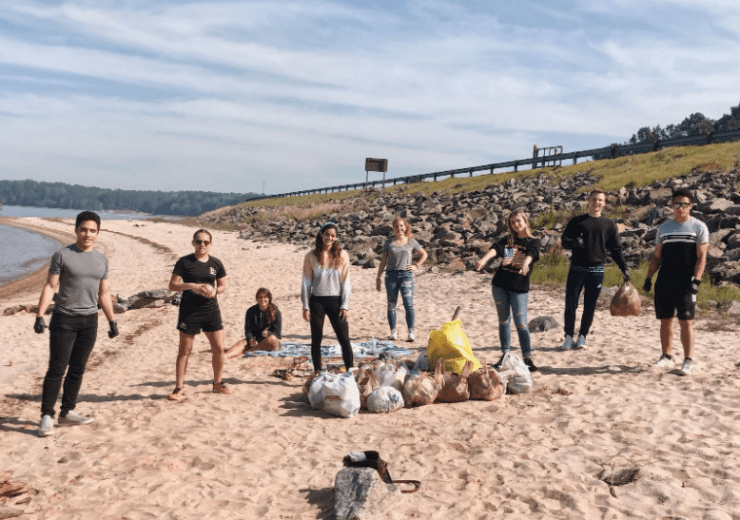
One student planned to recruit a group of fellow students to pick up litter on the West Point Lake beach. When she heard the shelter-in-place order was coming, she called her recruits, and they went just before the order took place and picked up lots of litter from one of the prettiest spots in the area. The picture below is that group – and you can see they maintained social distancing, as well!
Still another student planted a garden for his family – especially his mother. Playing in the dirt is certainly a thinking biblically kind of thing to do.
It is so encouraging to know that Point students can figure out ways to be Jesus to the world around them – even in these rather weird times. Somehow I think, in what I’ve been calling “the coming new world,” these students and many others will make a difference for the Kingdom.
I’m grateful I get to be one of their teachers. To borrow language from Volf and Kroasmun, they have figured out that “the purpose of theology is to discern, articulate, and commend visions of flourishing life in light of God’s self-revelation in Jesus Christ.”
 Wye Huxford
Reading how these students continued to show the light of Jesus in this dark time makes me a proud alumni. Thank you for sharing these stories.
LikeLike